June 30, 2026 10 min read

How to Create Better Feng Shui in Your Bedroom

By Early Settler

A bedroom can have the right furniture and still not feel right. Most of the time, it comes down to where things sit.

Feng Shui is the ancient Chinese practice of arranging your environment to support better energy flow. In a bedroom context, that means thinking carefully about how furniture is positioned, how much space is left clear, and how the room feels to move through, not just look at. You do not need to subscribe to every principle to benefit from it. A lot of the principles are just practical common sense about how a room works and how people move through it.

The result, if you get it right, is a room that actually helps you switch off. Calmer, more ordered, easier to be in. For most people, that is the goal regardless of what philosophy sits behind it.

Shop the full bedroom furniture range 

What does Feng Shui mean in a Bedroom?

Feng Shui (pronounced fung shway) translates roughly as 'wind and water'. It is a system developed thousands of years ago in China, based on the idea that the physical arrangement of a space affects the energy within it, and by extension, the wellbeing of the people who live there.

In a bedroom, the core principles translate to a few practical ideas: your bed should feel secure and grounded, the room should allow clear movement, clutter should be managed rather than hidden, and natural materials and calm colours help the room feel more restorative.

You do not need to follow every rule. But even applying two or three of these principles tends to make a measurable difference to how a bedroom feels.

Where should your bed be positioned?

This is the single most important decision in any Feng Shui bedroom layout, and it is one of the few areas where the guidance is consistent across almost every interpretation of the practice.

The principle is called the command position. Your bed should be placed so that you can see the door from where you lie, without being directly in line with the doorway. In practice, this usually means the bed sits diagonally opposite the door, against a solid wall, with clear sightlines across the room.

The reasoning is straightforward: lying with your back to the door, or directly in the door's path, creates a low-level sense of vulnerability. You are not fully at rest when part of your brain is still monitoring for entry. Moving the bed so you face the door with solid wall behind you removes that tension.

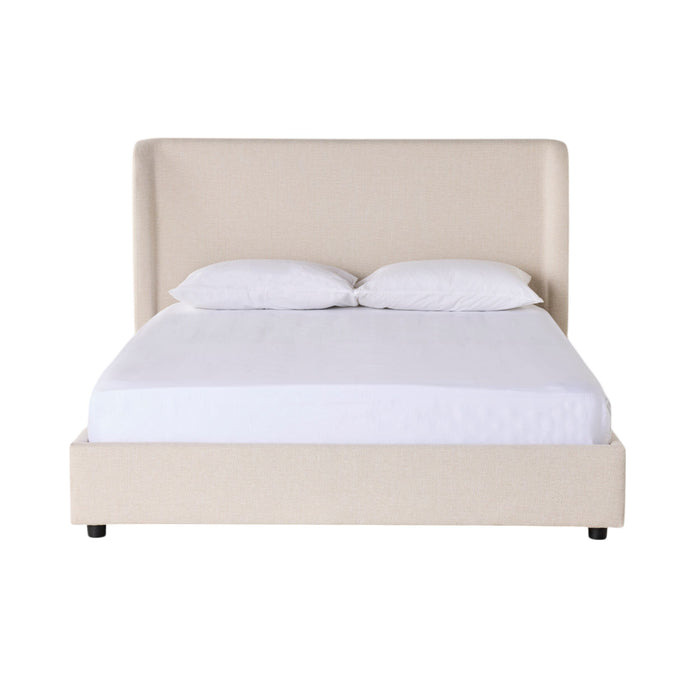
If your room layout makes this genuinely impossible, a tall, solid bedhead can help compensate. It creates a physical sense of backing and support where the wall cannot.

Browse Beds & Bed Frames

Does your bed frame actually matter?

More than people expect, yes.

Feng Shui places a lot of emphasis on the bed frame as a source of grounding energy in the room. The practical translation: a low, platform-style frame or a frame without a bedhead can feel unanchored. A solid timber frame or an upholstered bedhead with real height gives the bed a sense of weight and stability that affects how you feel in the room.

This does not mean you need something heavy or oversized. What you want is presence. A bed that looks like it belongs in the room, not like it was placed there temporarily.

Natural materials tend to perform better here than metal or plastic, both aesthetically and in terms of the settled quality they bring to the space. Timber and upholstery sit well in the calmer room environments that Feng Shui is trying to create.

Do you need matching bedside tables?

In a shared bedroom, yes. In a solo bedroom, it is less critical but still worth considering.
Feng Shui values balance and symmetry, particularly on either side of the bed. This is partly about visual balance (a bedside table on only one side can make the bed look lopsided in the room), but it is also about creating a sense of equality and equilibrium in the space.

Matching bedside tables with identical lamps is the most straightforward approach, but you can achieve the same result with pieces that are similar in scale and visual weight without being exact pairs. The key is that neither side of the bed should feel significantly heavier or more dressed than the other.

Practically, bedside tables also need to function. A surface at the right height for the bed, enough space for a lamp and a glass of water, and some storage if you need it. Getting the scale right matters as much as the aesthetic.

Browse Bedside Tables

What about the space around and under the bed?

Clear space underneath the bed is consistently emphasised in Feng Shui, and for once the principle has some practical backing too.

Storing things under the bed, particularly items that carry emotional weight like old paperwork, out-of-season clothing in overstuffed bags, or anything you have genuinely forgotten is there, creates a kind of low-level mental clutter. The room does not feel fully restful because the storage is not resolved.

If you need under-bed storage, use a proper storage bed. The storage is contained, intentional, and not visually intrusive. That is a fundamentally different situation from boxes and bags pushed under a standard frame.

The same principle applies to the floor around the bed. Keep the pathways clear on both sides. You should be able to walk around the bed without navigating obstacles.

Shop Bedroom storage

How do mirrors affect Bedroom energy?

Mirrors are one of the more genuinely contested areas of Feng Shui, and it is worth being honest about that.

The traditional guidance is to avoid placing a mirror directly facing the bed, on the basis that seeing your own reflection while half-asleep can be startling and unsettling, and that mirrors bounce energy around the room in ways that are not conducive to rest. Whether you find that persuasive or not, there is a fairly practical truth underneath it: a large mirror directly opposite the bed tends to dominate the visual field in a way that most people find overstimulating in a sleep space.

Mirrors positioned to the side of the bed, or on a wardrobe door that is not directly facing you, are generally fine. Used well, they reflect natural light, make the room feel larger, and add depth without the visual noise.

Dressers with integrated mirrors are particularly useful here because the mirror sits at standing height, which takes it out of the sightline when you are in bed.

Shop Mirrors

Which materials and colours work best?

Natural materials are a consistent theme in Feng Shui for bedrooms, and the reasoning is simple enough: timber, linen, cotton, and wool bring warmth and texture without visual aggression. They do not compete for attention the way highly polished surfaces, chrome, or synthetic materials can.

Timber bedroom furniture tends to ground a space. Upholstered pieces in soft neutral tones add texture without noise. These are not just aesthetic observations. A room with a lot of hard reflective surfaces reads differently to one built around matte, natural materials, and most people notice it even if they cannot articulate why.

For colours, the Feng Shui preference runs toward warm neutrals, earthy tones, and soft muted shades rather than stark whites or saturated colours. This aligns reasonably well with what most contemporary bedroom styling tends toward anyway. Deep greens, warm beiges, and soft terracotta all work well. Bright accent walls or bold pattern on every surface are harder to rest in.


Browse Timber Beds & Bed Frames

Browse Fabric Beds & Bed Frames

Does a rug make a difference?

Yes, and it is one of the easier changes to make.

A rug under the bed anchors the furniture grouping and gives the sleep zone a physical boundary within the room. That sense of defined space is something Feng Shui emphasises, and it has a real effect on how the room reads. Without a rug, a bed in the middle of a hard floor can look unresolved, like the furniture has not been properly settled into the room.

Size matters here. The rug should extend beyond the bed on three sides (or at minimum on both sides and the foot), so that when you step out of bed you land on something soft. A rug that only sits partially under the bed, with corners lifting or edges meeting the legs awkwardly, undoes the grounding effect you are trying to create.

For texture, something with a slight pile or woven texture tends to work better in a bedroom than a flat, hard-wearing weave. Wool rugs in particular have a warmth that reads well in this context.

Shop Rugs

How should you approach Bedroom lighting?

Overhead lighting is a problem in most bedrooms, and not just from a Feng Shui perspective.

A single ceiling light positioned above the bed creates harsh, direct light that is difficult to modulate and almost impossible to make feel relaxing. Feng Shui favours soft, layered lighting that can be adjusted according to the time of day and mood, and this is one of the more practical principles in the entire framework.

Bedside Lamps are the starting point. They create pools of warm light at the right height for evening reading and wind-down. A floor lamp in a corner adds ambient light without the harshness of an overhead fitting. If you have a ceiling light, put it on a dimmer.
Warm-toned bulbs (2700-3000K) make a significant difference compared to cool white. The colour temperature affects how the room feels more than most people realise until they change it.

Pendants can work well in this context too, but placement is the thing that makes or breaks them. A pendant hung directly above the bed, aimed downward, puts you back in the same problem as a ceiling light. Pendants used as bedside alternatives, hung lower on either side of the bed at roughly lamp height, are a different story. They create the same warm, pooled light as a table lamp, free up surface space on the bedside table, and can add a considered visual element that a standard lamp sometimes cannot. Just make sure the bulb is warm-toned and the shade diffuses rather than concentrates the light.

Browse Lamps

How do you add softness without clutter?

Texture and layering are both important in Feng Shui bedrooms, but there is a version of this that becomes its own problem. A bed buried under fifteen cushions and three throws is not calmer than a plain one. It is just more visually complex.

The goal is softness without accumulation. A quality quilt or bedspread, two to four Cushions that actually complement each other, and Blankets & throws folded at the foot of the bed. That is enough. The materials should add warmth, cotton, linen, or a light wool blend.

The same discipline applies to surfaces. One or two considered items on a bedside table. A plant if the room gets enough light and you will actually care for it. Clear floor space around the bed. Softness in specific places, restraint everywhere else.

Style with home decor

Shop low maintenance artifical plants


Feng Shui Bedroom do's and don'ts

A summary of the principles that tend to make the most practical difference:


Do's

Don'ts

Position your bed in the command position, where you can see the door without being directly in line with it

Push the bed against a wall in a way that blocks one side unless there is genuinely no other option

Use a solid bedhead to create a sense of backing and support

Place a large mirror directly facing the bed

Balance both sides of the bed with matching or similarly scaled bedside tables

Store unresolved clutter under the bed or on the floor around it

Keep floor space clear around the bed on both sides

Rely on a single overhead light as the only source in the room

Choose natural materials, timber, linen, wool, cotton, over synthetic or highly reflective alternatives

Overcrowd the room with furniture that interrupts natural pathways

Use layered lighting with bedside lamps as the primary source

Add texture and softness without editing, too much reads as clutter, not comfort

Anchor the bed zone with a rug that extends beyond the bed frame


Keep surfaces edited and intentional


Ready to rethink your bedroom? Browse the full bedroom furniture range at Early Settler


Frequently asked questions

  • The ideal bed position is the command position: placed so you can see the door from where you lie, without being directly in the path of the doorway. This typically means the bed sits diagonally opposite the door, against a solid wall, with clear sightlines across the room. A solid bedhead can compensate if your layout makes the command position difficult to achieve.

  • Feng Shui generally advises against placing a large mirror directly opposite the bed. The practical concern is that seeing your reflection while half-asleep can be unsettling, and a dominant mirror in the direct sightline tends to be visually stimulating in a space meant for rest. Mirrors positioned to the side of the bed, or on wardrobe doors that do not face you directly, are generally fine.

  • Avoid furniture that blocks the natural pathways around the bed, or that crowds the room to the point where moving through it feels obstructed. Storage that is unresolved, things pushed under the bed in a disorganised way, or surfaces cluttered with unrelated items, also works against the calm the room is trying to create. When storage is needed, a proper storage bed or a tallboy with closed drawers is a better choice than open shelving or informal solutions.

  • Yes, and there is a practical reason beyond the philosophical one. Timber, wool, linen, and cotton all bring warmth and texture without visual aggression. They tend to make a room feel quieter and more settled than rooms built around synthetic materials, highly polished surfaces, or chrome finishes. The difference is most noticeable when you are trying to create a genuinely restful environment rather than a stylish one.